

In partnership with

📰Weekly Intelligence: The Marketer’s AI Briefing
This week is about one thing: the infrastructure marketers have treated as stable is being rebuilt underneath them. Paid social, search, customer service, creative compliance. All of it. And the new rules are being written in real time.
Meta embedded an autonomous AI agent directly inside Ads Manager, and it is not a chatbot in a separate tab. Manus AI, acquired by Meta in late 2025, now sits inside the core navigation advertisers use every day. It can execute market research, build reports, and analyse campaign performance across multiple steps without a human approving each action. For anyone running paid social without a dedicated ops team, the job description just changed. Routine campaign administration becomes machine-executable. The human role inside Meta Ads is increasingly about strategic direction and creative judgement. Dashboard management is no longer a differentiator.
Google AI Overviews appeared 58% more frequently year-over-year, and ranking first in organic search no longer guarantees you get into the answer. Research from early March 2026 shows AI Overviews surging hardest in education, B2B tech, restaurants, finance, and insurance. The structural problem: AI Overviews regularly cite sources that differ from the top organic rankings. You can sit in position one and still get excluded from the summary that occupies the most prominent real estate on the page. Traditional results still appear for roughly 52% of queries, so this is a split environment, not a clean handover. But any content strategy still optimising purely for rank is now optimising for the wrong thing.
OpenAI launched an advertising pilot inside ChatGPT, with Criteo as its first ad tech partner, reaching a platform with more than 800 million weekly active users. The integration runs initially across Free and Go tiers in the US, with a revised privacy policy formalising ad targeting rules and data retention timelines. The economics make this inevitable: OpenAI spends an estimated nine billion dollars per year to operate, and most of those 800 million users have never paid for the service. Early data suggests LLM-referred traffic converts at higher rates than many traditional referral sources. This is the most significant new paid media surface to evaluate seriously since connected TV.
Zendesk is acquiring Forethought for over 200 million dollars, its seventh AI deal in roughly two and a half years. Its CEO has publicly projected that AI agents will handle more than half of all voice and chat customer service interactions on its platform within 2026. Forethought builds agentic AI systems that reason through problems and resolve them end-to-end, not follow a decision tree a human pre-wrote. Even if you never think about customer service software, this matters. The brand experience a customer has after they buy something is now being configured inside AI agent logic. Agent tone, knowledge boundaries, and escalation behaviour are brand strategy decisions, not IT tickets.
New York enacted a law requiring advertisers to disclose when ads feature synthetic performers, with civil penalties reaching 5,000 dollars per subsequent violation. Senate Bill S8420A, signed and taking effect mid-2026, covers AI-generated visual or audiovisual ads featuring a synthetic human face or body. Audio-only ads and AI language translation are exempt. A companion bill extends similar protections to deceased performers. New York tends to function as a regulatory template for other states. The window to build disclosure workflows into your AI creative production is now, not after the next jurisdiction follows.
The pattern: it is not that one channel is changing. It is that all of them are changing at the same time, and the decisions being made inside paid media, search, customer experience, and compliance are increasingly connected. The marketers who treat these as separate workstreams will find out the hard way that they are not. The question is not whether to engage with these shifts. It is which ones have the shortest fuse
✍Andy’s Take
I built a SaaS That Sells Itself to AI Agents. Here's What That Taught Me.
AI agents are discovering, evaluating, and subscribing to software on their own. I built a product for this market before most people noticed it existed. Here's what I learned.
A new distribution channel is forming. Most marketers haven't noticed it yet. I built a product for it.
Something is shifting in how software gets discovered.
Not theoretically. Actually.
AI agents are starting to find, evaluate, and subscribe to software tools on their own. Without a human in the loop. While the person who set them running is doing something else entirely.
If that sounds like a stretch, I thought the same thing. Then I started paying close attention to what happened with OpenClaw, and a few things clicked into place.
The Moment That Changed My Thinking
OpenClaw is an open-source AI agent framework that went from zero to 250,000 GitHub stars faster than almost anything in recent memory. Somewhere between 300,000 and 400,000 people are now running OpenClaw agents.
The reason it spread so fast: it doesn't just answer questions. It takes action. It manages email, deploys code, negotiates on your behalf, operates software tools. Autonomously.
Here's the detail that matters for marketers.
OpenClaw agents discover and install "skills," which are modular tools that extend what they can do. There's a marketplace called ClawHub with over 13,000 skills listed. Agents browse it using semantic search, evaluate options, and in many cases subscribe to paid services without asking their owner.
Most agents operate with a daily spending limit of $5 to $10 set by their owner. Within that budget, they have discretion. If a tool costs $9 per month and an agent needs it to complete a task, it subscribes.
The agent economy is real. And it's opening a distribution channel that barely anyone is building for.
What Made It Concrete
The signal came from Postiz, a social media scheduling tool. They were competing with Buffer, Hootsuite, and a dozen other established players. Nothing that should stand out on paper.
Then they made one move. They built a CLI, a command line interface, installable via npm. They added a SKILL.md file so OpenClaw agents could discover it automatically. They returned structured JSON output so agents could parse responses without navigating a web dashboard.
Their founder was direct about what happened:
Revenue went from modest numbers to over $45,000 in monthly recurring revenue.
They didn't build a better product. They built the same product with a different interface. One that AI agents could actually use. Agents chose Postiz over Buffer and Hootsuite because those tools have no CLI. No SKILL.md. They're invisible.
That was the lightbulb moment. If agents are becoming buyers, what do they need that doesn't exist in agent-native format yet?
Finding the Gap
I started mapping what AI agents actually do when they run marketing workflows.
They can write copy. Schedule posts. Send emails. Generate images.
But what happens when they need a tracked link?
Every marketing campaign needs UTM parameters, the tags you add to URLs so your analytics can tell you which campaign, source, and medium drove the traffic. Without them, attribution is guesswork.
The numbers are uncomfortable. Around 64% of companies have no consistent UTM naming convention, which leads to roughly 22% of analytics data being unreliable. Social posts without proper Open Graph tags get two to three times fewer clicks. Every second of page load delay costs around 7% in conversions.
I looked at every UTM builder on the market. UTM.io. Bitly. Google's Campaign URL Builder. CampaignTrackly.
Every single one has a web dashboard. Some have APIs. Not one has a CLI installable from npm. Not one ships a SKILL.md. Not one returns structured JSON designed for agents. Not one has an MCP server.
The entire UTM builder category was invisible to AI agents.
A universal marketing need, with zero agent-native solutions.
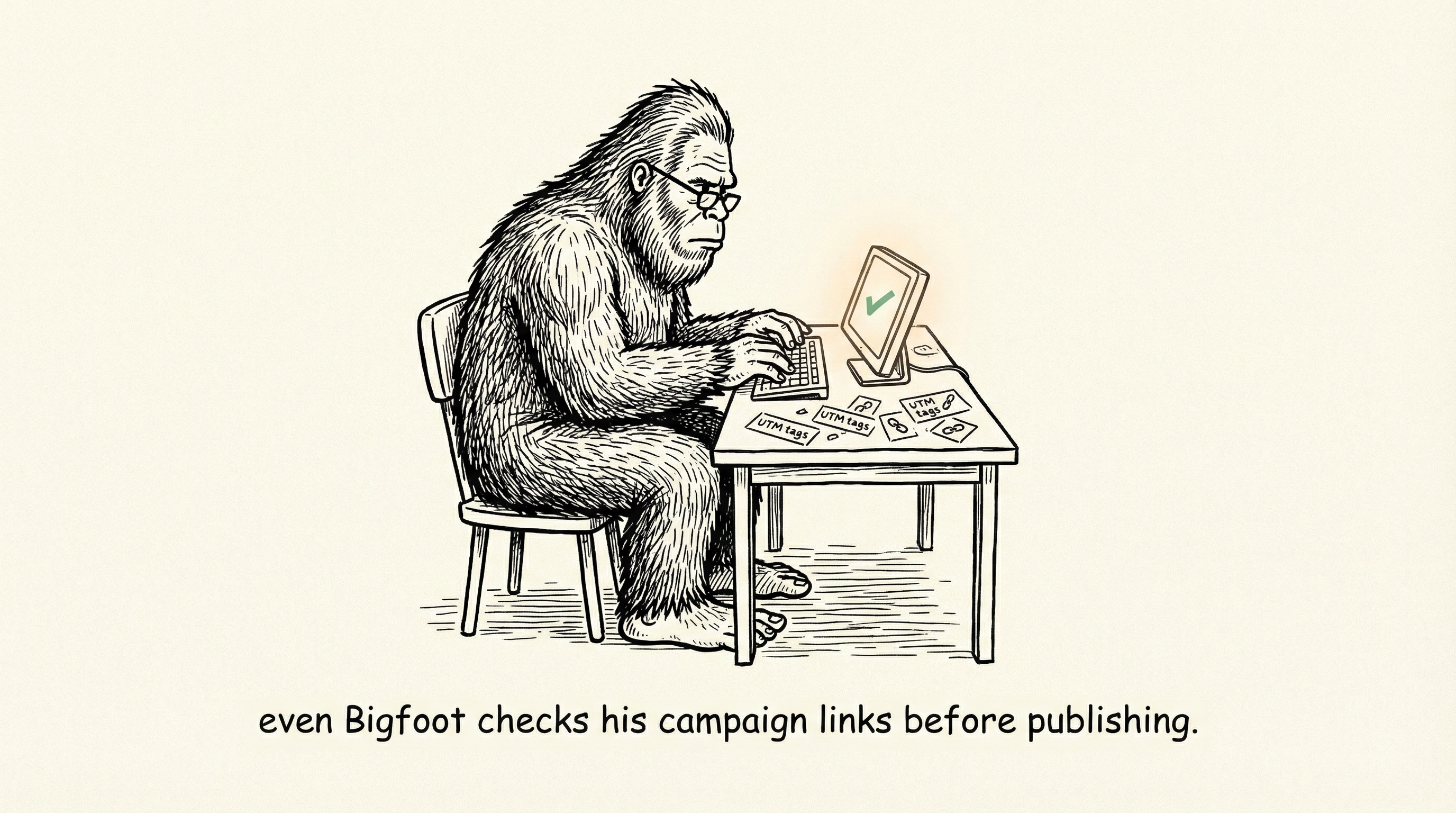
That's where MissingLinkz came from. The name is a double play on the missing link in the agent marketing stack, with a Bigfoot mascot because Bigfoot is the original missing link.
🤝This Week’s Sponsor
How Marketers Are Scaling With AI in 2026

61% of marketers say this is the biggest marketing shift in decades.
Get the data and trends shaping growth in 2026 with this groundbreaking state of marketing report.
Inside you’ll discover:
Results from over 1,500 marketers centered around results, goals and priorities in the age of AI
Stand out content and growth trends in a world full of noise
How to scale with AI without losing humanity
Where to invest for the best return in 2026
Download your 2026 state of marketing report today.
Get Your Report
🗺️How To Create An AI Roadmap In 3 Minutes
Most marketing teams don’t actually have an AI problem.
They have a clarity problem.
Everyone knows AI matters. Tools are being tested. Experiments are happening. But when you ask simple questions like “Where are we today?” or “What should we focus on next?” the answers tend to get vague very quickly.
That’s exactly why I built the AI Marketing Roadmap.
It’s a free interactive diagnostic that takes about three minutes. You answer eight focused questions about your tools, workflows, and team confidence with AI. The system then scores your maturity and generates a personalised 30/60/90-day roadmap for what to do next.
You’ll get:
• A clear AI maturity score across four key areas
• Your highest-impact opportunities ranked
• A practical 30/60/90-day plan with suggested KPIs
• A downloadable report you can share with your team
No credit card. No theory. Just a clear starting point.
If you’re trying to move from AI curiosity → AI capability, this is a good place to begin.
👉 Try it here: roadmap.goodvibemarketer.com
